Old Instrument
Photos
The magazines and coffee table books are full of studio photos
of classic (expensive) violins. I thought you might like to browse
with me among these affordable ones by unsung artists, such as you
and I might find in our "collections." They will serve to
illustrate the variety of violins to those who may think "they all
look alike." This is arranged for a pleasant pictorial
browse.
Click on a small photo to
enlarge it; then go BACK to
return.
These are mostly impromptu snapshots taken in our rose garden and
apple orchard , but the form of the violin is universal enough to
survive, thrive, even in that setting. Most were taken in sunlight
with my old SLR. More to come - it's interesting, but I don't have
much time for this. . . (Beginning with the Friedrich I am using my
new digital camera. Newer photos will be placed at the top of this
page.)
Bass Viol (Viola da Gamba)
 Every violin shop should
have at least a token viol on display, and this is ours, apparently
an older English one by Thomas M. Anselmi - at least he signed it
several places inside. It had been terribly refinished and fitted
with Caspari cello pegs, so we bushed it and varnished it with my
brown walnut oil & and pine resin varnish, color augmented with
Gubbio red pigment.
Every violin shop should
have at least a token viol on display, and this is ours, apparently
an older English one by Thomas M. Anselmi - at least he signed it
several places inside. It had been terribly refinished and fitted
with Caspari cello pegs, so we bushed it and varnished it with my
brown walnut oil & and pine resin varnish, color augmented with
Gubbio red pigment.
Ornate Cello

 One of the more visually
spectacular instruments to find its way into my shop for repair, it
was made ca. 1915 in Cleveland by Bernhardt Kimpel, a German born
cabinetmaker and amateur violin maker d.1946. According to Wenberg
this cello is made of some 600 pieces of 10 species of wood.
Apparently maple and walnut predominate. While the ribs are
veneered with marquetry, the front, back, and neck are made of
solid joined wood strips.
One of the more visually
spectacular instruments to find its way into my shop for repair, it
was made ca. 1915 in Cleveland by Bernhardt Kimpel, a German born
cabinetmaker and amateur violin maker d.1946. According to Wenberg
this cello is made of some 600 pieces of 10 species of wood.
Apparently maple and walnut predominate. While the ribs are
veneered with marquetry, the front, back, and neck are made of
solid joined wood strips.
Nyckelharpa
 A
rare sight in a violin shop, this modern example of the Swedish
Nyckelharpa ("keyed harp") was smashed in transit from Sweden, and
we put it back together for a friend - not our usual line of work.
Earlier forms existed in the 9th C. and ones similar to this from
the 16th. Reminiscent of the hurdy-gurdy, but played (much more
expressively) with a bow instead of a wheel. Bowed strings A C G C,
12 sympathetic resonance strings, and 37 keys to stop the bowed
strings. A strong, silvery sound.
A
rare sight in a violin shop, this modern example of the Swedish
Nyckelharpa ("keyed harp") was smashed in transit from Sweden, and
we put it back together for a friend - not our usual line of work.
Earlier forms existed in the 9th C. and ones similar to this from
the 16th. Reminiscent of the hurdy-gurdy, but played (much more
expressively) with a bow instead of a wheel. Bowed strings A C G C,
12 sympathetic resonance strings, and 37 keys to stop the bowed
strings. A strong, silvery sound.
David Tecchler violin Rome 1704


 Label seems original, excellent scroll. Front half-edged. Expert restoration work stamped by (Henry) Schetelig, Brooklyn, NY, born in Saxony, Germany (Markneukirchen), came to America 1886, independent shop 1897.
Be sure to click on the photos to magnify them; use the back arrow to return.


Old Brescian violin?? ca. 1575?


 Unlabeled. Plain workmanship,
soundholes without wings, long neck, opaque wood, thin ribs,
scribed purfling, archaic scroll and neck. Some similarities to
Zanetto.
Unlabeled. Plain workmanship,
soundholes without wings, long neck, opaque wood, thin ribs,
scribed purfling, archaic scroll and neck. Some similarities to
Zanetto.
M. S. Fuller, 1907


 Labeled M. S. Fuller 1907/R.F.D No.
6/Salem Ore No. 19, primitive charming local violin, broad volute
on scroll, but very good shaded varnish. A grand pen and ink
polychrome painted eagle with American flag on the lower back
initialed C.F. (perhaps the maker's wife or daughter?), beautiful
burl ribs, not loud, but hard to beat as a patriotic decoration! Fine folk art.
Labeled M. S. Fuller 1907/R.F.D No.
6/Salem Ore No. 19, primitive charming local violin, broad volute
on scroll, but very good shaded varnish. A grand pen and ink
polychrome painted eagle with American flag on the lower back
initialed C.F. (perhaps the maker's wife or daughter?), beautiful
burl ribs, not loud, but hard to beat as a patriotic decoration! Fine folk art.
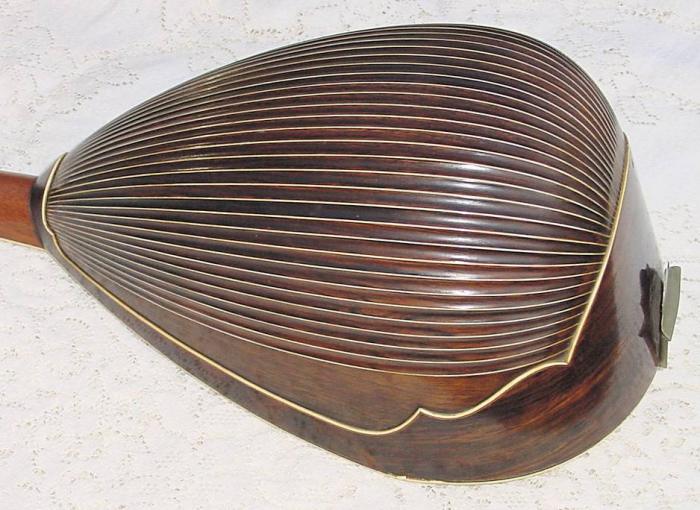
Beautiful Martin Mandolin, 1899


Violins are elegant, graceful, and economical in design (if a bit
monotonous). But lutes and mandolins may have, without
embarrassment, exquisite decorative beauty. The mandolin is related
to the violin, at least in it's identical tuning, if not in it's
fretting and double stringing, and I couldn't resist showing these
photos taken on our back porch tablecloth. The plate on the back of
the head and the channeling in the rosewood ribs are wonderful.
Take a look, even though (maybe because) these are large pictures.
This made such a nice change from fiddles that I put up some other
pictures of "plucked" instruments that decorate the walls of my
shop, including a rare fretted violin (or bowed zither) etc. You
will find these at the bottom of this page.
Jakob Stainer (old copy)


 Like the best
Cremonese makers, Austria's Stainer is much maligned by the
ubiquitous, awful "copies," really caricatures, in which "imitation
is (not) the sincerest form of flattery." Here, however, we have a
particularly nice one. The birdseye figure is not quite as tight,
but the model, arching, and edges are right, even the handwritten
label is plausible - Jacobus Stainer in Absam, prope Oenipontum
1652. One piece lower rib with inlet saddle and inverted
"V"center marking notch on the lower edge. Providentially, this
violin seems to sing in the best Staineresque timbre, as set
primarily by the arching, but full and free, making it
understandable that Stainers were, in their day, preferred to
Stradivaris.
Like the best
Cremonese makers, Austria's Stainer is much maligned by the
ubiquitous, awful "copies," really caricatures, in which "imitation
is (not) the sincerest form of flattery." Here, however, we have a
particularly nice one. The birdseye figure is not quite as tight,
but the model, arching, and edges are right, even the handwritten
label is plausible - Jacobus Stainer in Absam, prope Oenipontum
1652. One piece lower rib with inlet saddle and inverted
"V"center marking notch on the lower edge. Providentially, this
violin seems to sing in the best Staineresque timbre, as set
primarily by the arching, but full and free, making it
understandable that Stainers were, in their day, preferred to
Stradivaris.
John Friedrich 1858-1943

 This eye-catching violin reminded me of the
"American Beauty" article by David Bromberg in the November 2000
Strad. Born in Germany, John and William Friedrich long operated
the firm of John Friedrich & Bro. in New York. This antiqued
"Guarneri" model is dated 1931. It is unclear to what extent it was
imported or made in NY, but clearly in the style of his "American
violins."
This eye-catching violin reminded me of the
"American Beauty" article by David Bromberg in the November 2000
Strad. Born in Germany, John and William Friedrich long operated
the firm of John Friedrich & Bro. in New York. This antiqued
"Guarneri" model is dated 1931. It is unclear to what extent it was
imported or made in NY, but clearly in the style of his "American
violins."
J. B. Squier, "The American
Stradivarius"


 Labeled
1890/Jerome Bonaparte Squier Maker/No. 192 Boston (elegant label on
a black background), made by one of the great American makers and
father of Victor Carroll Squier, of the V.C. Squier Co.,
manufacturer of strings and instruments in Battle Creek, Michigan.
Reddish varnish (a glaze over gold), a fine violin. Handwritten
inside on the upper block : " This violin is made of very old
Italian wood. June 1890 J.B. Squier." Ex Estelle LaMont, b.
Michigan, who played it in the San Diego Symphony. See Two
Generations of American Violin Makers, Journal of the VSA,
Vol. V, No. 1.
Labeled
1890/Jerome Bonaparte Squier Maker/No. 192 Boston (elegant label on
a black background), made by one of the great American makers and
father of Victor Carroll Squier, of the V.C. Squier Co.,
manufacturer of strings and instruments in Battle Creek, Michigan.
Reddish varnish (a glaze over gold), a fine violin. Handwritten
inside on the upper block : " This violin is made of very old
Italian wood. June 1890 J.B. Squier." Ex Estelle LaMont, b.
Michigan, who played it in the San Diego Symphony. See Two
Generations of American Violin Makers, Journal of the VSA,
Vol. V, No. 1.
Johann Ulrich Eberle


 Labeled Joannes Udaldricus Eberle/fecit Prag' 1753 (original
parchment label), also with repair label Opravil 19 -
Reparavit/Bohuslav Lantner/Praha Prague, original scroll invisibly
grafted onto new pegbox, which is grafted onto a new neck. This
prolific prime exponent of the German school also made many
wonderful violas d'amore. Ex Bernard Kornblum collection; it has a
symbolic interest for me; my mother's name is Eberle. Photographs
of this authentic instrument occupy a page, plate 38, in Jalovec's
The Violin Makers of Bohemia. See also the photos on pages
47 and 70 of Art & Method of the Violin Maker by Henry
A. Strobel.
Labeled Joannes Udaldricus Eberle/fecit Prag' 1753 (original
parchment label), also with repair label Opravil 19 -
Reparavit/Bohuslav Lantner/Praha Prague, original scroll invisibly
grafted onto new pegbox, which is grafted onto a new neck. This
prolific prime exponent of the German school also made many
wonderful violas d'amore. Ex Bernard Kornblum collection; it has a
symbolic interest for me; my mother's name is Eberle. Photographs
of this authentic instrument occupy a page, plate 38, in Jalovec's
The Violin Makers of Bohemia. See also the photos on pages
47 and 70 of Art & Method of the Violin Maker by Henry
A. Strobel.
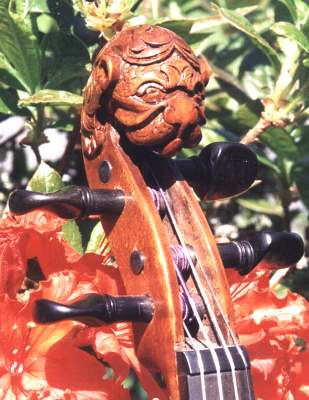
Lion's Head Example
 A fine bit
of carving at the head of this otherwise ordinary late 19th C.
violin. Probably composite "homework," by different specialists, as
the head carver most frequently was. In this case the other
cobblers of the fiddle were of a lower level of artistry. Labor was
cheap in those days compared to the price of materials as ebony,
leading to the manufacture of composite fingerboards of pear wood
veneer over spruce, being at least fortuitously
lightweight.
A fine bit
of carving at the head of this otherwise ordinary late 19th C.
violin. Probably composite "homework," by different specialists, as
the head carver most frequently was. In this case the other
cobblers of the fiddle were of a lower level of artistry. Labor was
cheap in those days compared to the price of materials as ebony,
leading to the manufacture of composite fingerboards of pear wood
veneer over spruce, being at least fortuitously
lightweight.
Modern English Violin
 Labeled
fecit 1954/Dei gratia (with monogram RB in circle), made
by Richard Blois, his personal violin (he died several years ago on
the Oregon coast), with his leather case, etc., beautiful, golden
(gamboge) varnish, one piece back, mint, probably made in London.
In Wenberg: "Blois, Richard C. T.:, Monterey, CA. C. 1920- Born in
London, England. [Note: I was recently informed that he was
actually born in NYC, where his concert pianist mother was on tour.
He was taken back to England at a very young age and grew up
there.] Studied to be a concert pianist at the Royal Academy of
Music . . . Later moved to Pasadena in the late 1950's, and studied
violin repair under Herbert Gray c. 1965. . . Also a composer and
artistic painter. Label no. 29."
Labeled
fecit 1954/Dei gratia (with monogram RB in circle), made
by Richard Blois, his personal violin (he died several years ago on
the Oregon coast), with his leather case, etc., beautiful, golden
(gamboge) varnish, one piece back, mint, probably made in London.
In Wenberg: "Blois, Richard C. T.:, Monterey, CA. C. 1920- Born in
London, England. [Note: I was recently informed that he was
actually born in NYC, where his concert pianist mother was on tour.
He was taken back to England at a very young age and grew up
there.] Studied to be a concert pianist at the Royal Academy of
Music . . . Later moved to Pasadena in the late 1950's, and studied
violin repair under Herbert Gray c. 1965. . . Also a composer and
artistic painter. Label no. 29."
Hungarian Violin

 Labeled
Javitotta/Brueckner
Nandor/hangzer-keszitof/Budapest/Raktdr
: Magyar-utcza 4, sz., a pretty, well made, antique looking
Stradivari model, grafted. Actually a very nice copy. Ferdinand
Brueckner was born in Budapest, Hungary
in 1848, and studied under Adolf
Moennig.
Labeled
Javitotta/Brueckner
Nandor/hangzer-keszitof/Budapest/Raktdr
: Magyar-utcza 4, sz., a pretty, well made, antique looking
Stradivari model, grafted. Actually a very nice copy. Ferdinand
Brueckner was born in Budapest, Hungary
in 1848, and studied under Adolf
Moennig.
Classic German Violin


 Unlabeled, another very
interesting, very old violin, idiosyncratic ears on the scroll but
this violin exudes quality, witnessed by careful restoration work.
Pegbox grafted, bushed, cheeked, nice rich brown transparent
varnish. Maybe Viennese, a violin to cherish. Purity of tone, easy
playing, remarkably 5.5 mm of original wood in the front center
although light elsewhere.
Unlabeled, another very
interesting, very old violin, idiosyncratic ears on the scroll but
this violin exudes quality, witnessed by careful restoration work.
Pegbox grafted, bushed, cheeked, nice rich brown transparent
varnish. Maybe Viennese, a violin to cherish. Purity of tone, easy
playing, remarkably 5.5 mm of original wood in the front center
although light elsewhere.
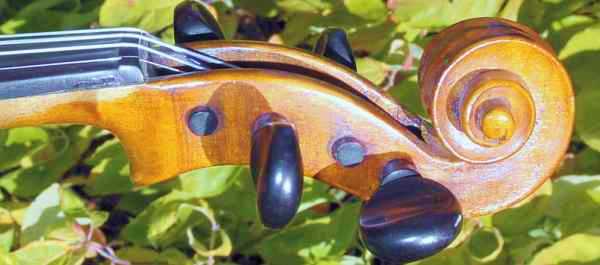
Nice Violin with Worn Varnish


 An old,
lightweight, good sounding violin bearing a patently misplaced J.U.
Eberle parchment label, which hardly warrants a Tommaso E.
attribution! But yes I might guess Italian, and certainly a nice
scroll.
An old,
lightweight, good sounding violin bearing a patently misplaced J.U.
Eberle parchment label, which hardly warrants a Tommaso E.
attribution! But yes I might guess Italian, and certainly a nice
scroll.
18th C. Hopf Violin
 Stamped * HOPF * inside,
HOPF (with individual letter stamps) on back under button,
handwritten inside "John G. Henrici/Violin Repairer/Resident No. 40
10th Street, Portland, Oregon, Dec. 6 1888," a better than usual
Hopf model, handsome one piece back, ca. 1780?, possibly by David
August I or II, said to have used such "cartwheels" (asterisks)
either side of the name, neck was broken and repaired.
Stamped * HOPF * inside,
HOPF (with individual letter stamps) on back under button,
handwritten inside "John G. Henrici/Violin Repairer/Resident No. 40
10th Street, Portland, Oregon, Dec. 6 1888," a better than usual
Hopf model, handsome one piece back, ca. 1780?, possibly by David
August I or II, said to have used such "cartwheels" (asterisks)
either side of the name, neck was broken and repaired.
18th C. German Violin


 A
favorite example of a violin of this school, it strikes one as very
different, but strongly beautiful in its own style sounding
robustly if Staineresque. A long narrow pegbox over a "chesty" body
with 50 mm between the upper f's! The original label of an honest
if unsung maker of Klingenthal (or thereabouts) named Johann
Friedrich Hoyer (ca. 1750) is characteristically glued onto the
inner right middle rib.
A
favorite example of a violin of this school, it strikes one as very
different, but strongly beautiful in its own style sounding
robustly if Staineresque. A long narrow pegbox over a "chesty" body
with 50 mm between the upper f's! The original label of an honest
if unsung maker of Klingenthal (or thereabouts) named Johann
Friedrich Hoyer (ca. 1750) is characteristically glued onto the
inner right middle rib.
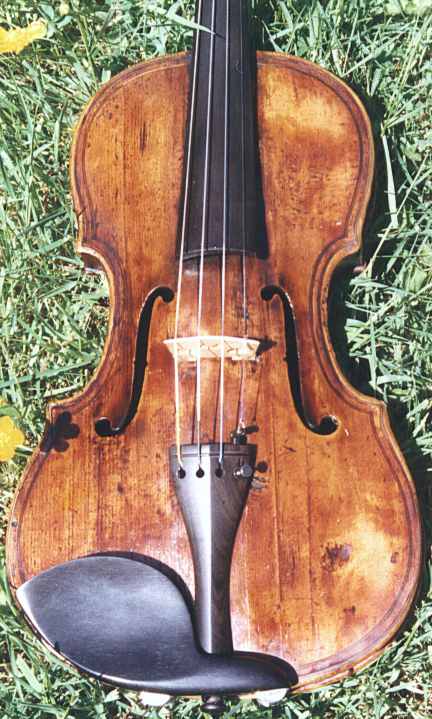
Beautiful Classic Violin


 Unidentified
classical Italianate violin, Venetian red over gold, exhibiting
beautiful wear and craquele. The quintessential "interesting
violin," that speaks to us, if only we knew what. Value hangs on
the hinge of attribution, a pitfall to be resisted, even by the
"expert." Such fiddles in times past, and not so past, have been
sanguinely and retroactively labelled. But wishing does not make it
so. Still a nice violin, whoever made it.
Unidentified
classical Italianate violin, Venetian red over gold, exhibiting
beautiful wear and craquele. The quintessential "interesting
violin," that speaks to us, if only we knew what. Value hangs on
the hinge of attribution, a pitfall to be resisted, even by the
"expert." Such fiddles in times past, and not so past, have been
sanguinely and retroactively labelled. But wishing does not make it
so. Still a nice violin, whoever made it.
"Hoosier" Violin

 No, not an old
violin, this sweet and easy playing country fiddle is a gift made
of silver maple for me by my friend Jerry Kelley back home in
Indiana. (He's playing a Strobel violin in this
picture.)
No, not an old
violin, this sweet and easy playing country fiddle is a gift made
of silver maple for me by my friend Jerry Kelley back home in
Indiana. (He's playing a Strobel violin in this
picture.)
Very Old Ornate Violin


 This very old violin is also
very lightly built, this delicateness being echoed in the
ultra-fine (very narrow) "vermicelli" purfling. A very dark tone,
yet pure, not tubby. What a nicely turned ear on the scroll. "Vive
la difference."
This very old violin is also
very lightly built, this delicateness being echoed in the
ultra-fine (very narrow) "vermicelli" purfling. A very dark tone,
yet pure, not tubby. What a nicely turned ear on the scroll. "Vive
la difference."
"Ancient" Violin


 This very old
violin is perhaps Brescian. Fully double purfled and with a fine
head, it is large (363 mm) with a large sound. The size is
reminiscent of those times when makers such as Andrea Amati made
both large and little fiddles, as opposed to those of the latter
19th century, who made overlong violins by adding the width of the
tracing pencil too many times. Fully double purfled, and with
interesting stuff on the back, it has a partially legible
Tieffenbrucker (Gaspard Duiffoprugcar) label, suspect, as they
are.
This very old
violin is perhaps Brescian. Fully double purfled and with a fine
head, it is large (363 mm) with a large sound. The size is
reminiscent of those times when makers such as Andrea Amati made
both large and little fiddles, as opposed to those of the latter
19th century, who made overlong violins by adding the width of the
tracing pencil too many times. Fully double purfled, and with
interesting stuff on the back, it has a partially legible
Tieffenbrucker (Gaspard Duiffoprugcar) label, suspect, as they
are.
Small Old Viola


 The maker's label
is hand-written and appears to be original, although the brownish
ink is faded and difficult to read in period script: "Johannes
Gullich, Lauten und Instrumentenmacher
in Mannheim, Maerz 1799" I.e. John
Gullich (or Guellich), Lute and
Instrument maker in Mannheim (Germany), March 1799 - a nice round
200 years old. He died 27 March, 1837, the son of and successor to
Mathias G., 1714-1803. There is also a repairer's label, considered
authentic: "Reparirt von Heinrich Eckard in Mannheim."
Eckard lived from 1811 until after 1878. The lower rib is in one
piece. The grain of the front is extremely fine, the wood otherwise
very plain. It is very light weight and good sounding. This is a
small viola, 15 5/8 inches or 397 mm, the same length incidentally
as the small violas I made after Louis Kievman's Gasparo da Salo,
but the neck and string length are those of a larger viola, 150 mm
and 375 mm, at least with the bridge between the f-notches,
maintaining the string tension. The corpus is ample, with a (more
or less uniform) rib height of 39 mm, an upper width of 195 mm,
middle of 135, and lower of 233, all over the back arching. Yes,
indeed the neck is grafted; you can just see the curved line under
the peg.
The maker's label
is hand-written and appears to be original, although the brownish
ink is faded and difficult to read in period script: "Johannes
Gullich, Lauten und Instrumentenmacher
in Mannheim, Maerz 1799" I.e. John
Gullich (or Guellich), Lute and
Instrument maker in Mannheim (Germany), March 1799 - a nice round
200 years old. He died 27 March, 1837, the son of and successor to
Mathias G., 1714-1803. There is also a repairer's label, considered
authentic: "Reparirt von Heinrich Eckard in Mannheim."
Eckard lived from 1811 until after 1878. The lower rib is in one
piece. The grain of the front is extremely fine, the wood otherwise
very plain. It is very light weight and good sounding. This is a
small viola, 15 5/8 inches or 397 mm, the same length incidentally
as the small violas I made after Louis Kievman's Gasparo da Salo,
but the neck and string length are those of a larger viola, 150 mm
and 375 mm, at least with the bridge between the f-notches,
maintaining the string tension. The corpus is ample, with a (more
or less uniform) rib height of 39 mm, an upper width of 195 mm,
middle of 135, and lower of 233, all over the back arching. Yes,
indeed the neck is grafted; you can just see the curved line under
the peg.
Fine Scottish Violin by Wm. Arbuckle, Glasgow,
1895.
 The arching and edgework are wonderfully crisp and personal. This
is in my private collection as a happy recollection of my three
years in Ayrshire, Scotland as an Air Force Officer.
The arching and edgework are wonderfully crisp and personal. This
is in my private collection as a happy recollection of my three
years in Ayrshire, Scotland as an Air Force Officer.
Bowed Zither (or Fretted Violin), Concert Zither,
and Italian Style Mandolin


 The Bowed Zither
is tuned like a violin, played with a violin bow, and has an arched
fingerboard. A very rare 19th century folk instrument from southern
Germany, it was played flat on the table in front of the
"performer." Three sharp points on the back kept it from sliding.
This one is labeled Herman Muller, San Francisco, probably
the seller rather than the maker.
The Bowed Zither
is tuned like a violin, played with a violin bow, and has an arched
fingerboard. A very rare 19th century folk instrument from southern
Germany, it was played flat on the table in front of the
"performer." Three sharp points on the back kept it from sliding.
This one is labeled Herman Muller, San Francisco, probably
the seller rather than the maker.
The Concert Zither is played with picks on a
portable table, the chords (Begleit) coming from the color coded
groups of strings beyond the fretboard. Still popular in Germany
and Austria, it is familiar, if at all, to Americans from
occasional restaurant entertainment or from the theme of the
postwar Graham Greene movie The Third Man. This one is
labeled P. Ed. Loenes, Zithern Fabrik Lager, Trier,
Germany.
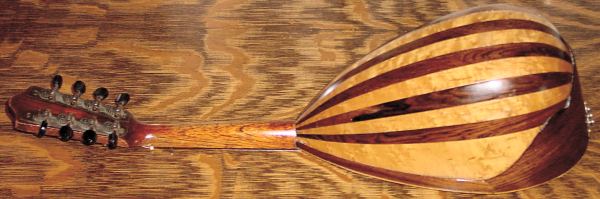
 The
"Italian" Mandolin is labeled L. Ricca..
4208, Manufacturer, New York NY. Different from the flat Bluegrass
style, this classical version, when played by hillbillies was
termed a "tater bug" (potato beetle) from its resemblance to the
alternate birdseye maple and rosewood ribs pattern.
The
"Italian" Mandolin is labeled L. Ricca..
4208, Manufacturer, New York NY. Different from the flat Bluegrass
style, this classical version, when played by hillbillies was
termed a "tater bug" (potato beetle) from its resemblance to the
alternate birdseye maple and rosewood ribs pattern.
HOME
Copyright 1999-2010 Henry
Strobel
 Every violin shop should
have at least a token viol on display, and this is ours, apparently
an older English one by Thomas M. Anselmi - at least he signed it
several places inside. It had been terribly refinished and fitted
with Caspari cello pegs, so we bushed it and varnished it with my
brown walnut oil & and pine resin varnish, color augmented with
Gubbio red pigment.
Every violin shop should
have at least a token viol on display, and this is ours, apparently
an older English one by Thomas M. Anselmi - at least he signed it
several places inside. It had been terribly refinished and fitted
with Caspari cello pegs, so we bushed it and varnished it with my
brown walnut oil & and pine resin varnish, color augmented with
Gubbio red pigment.